

Playing Left-Handed
In my late teens, I walked into the most famous music shop in my area and asked for my first classical guitar.
I loved the sound of guitars in the music I listened to. Rock, alternative rock, heavier things that arrived later. It was the feeling of strings, distortion, riffs, melody, and the possibility that a person could take something internal and let it come out as sound.
I did not yet know what I wanted to do with it.
I had never really tried to write a song, and I still have not. But I wanted to touch that world. To make some of those sounds myself. To have a guitar in the room, to play it in the evening, as a way of entering music from the inside rather than only listening to it from the outside.
The owner of the shop himself happened to be the one helping me.
I told him I was left-handed and wanted a left-handed guitar.
He looked at me, smiled, and said something like: “It will be hard to find one. And what will you do if you are at a friend’s place?”
It sounded practical.
Reasonable.
Almost adult.
So I bought a regular guitar.
And for many years, that small decision shaped my relationship with music.
Not entirely by choice, but by convenience, by someone else’s reasoning, and by the path of least resistance.
Operating a Guitar
I learned to play.
I took lessons for years. I played chords, songs, accompaniments, small pieces of music that could fill an evening or support a voice. Over time, the guitar became part of my life, but not fully in the way I had imagined.
I used to say that I was not really playing the guitar.
I was operating it.
The phrase was a joke, but it was also true. I could make it work. I could use it as an instrument beside singing, as something to add to a day, a project, a moment. But I did not feel that I was flowing with it. Something in the body remained slightly indirect, as if the music had to pass through a small administrative office before becoming sound.
There were clues.
Once, during a lesson, a new teacher noticed that I was not playing with my dominant hand. He was not especially tactful about it. His face said, almost immediately, that I should not expect a great career.
He may not have meant to wound me. But the message stayed.
At the same time, over the years, I spoke with many musicians — including left-handed ones — who told me that changing hands would not make any real difference. It would be a waste, they said. I had already invested too much in the current arrangement. Better to continue.
And maybe they were right.
Or maybe they were right for someone else.
That is one of the difficult things about advice. It can be intelligent, experienced, and still not fully belong to your body.
The Idea Returns
The idea of playing left-handed returned many years later.
Not as a dramatic revelation. More like a small question that would not completely disappear:
What if the problem was not the guitar?
What if it was the direction?
I did not rush to act on it. For a long time, I did not believe it would really change much. Buying another guitar felt like it might become one more unnecessary expense, another experiment that would sit in the corner. Life was also full of moves, transitions, other practices, other priorities. Music, for long periods, moved to the side.
It took me around five years to actually buy a left-handed guitar.
When I finally did, I expected to start from zero.
And in many ways, I did.
At first, I thought of it almost as an exercise for the brain. Something interesting, perhaps useful, but not necessarily emotional. I did not imagine it would eventually lead to joy, flow, or the feeling that the guitar had become possible again.
For a long time, even after switching, I still lacked a real practice environment.
The need to go to an office, the rhythm of work, the lack of structure — all of that made continuity difficult. I could feel that the change mattered, but I did not yet know how to turn it into a living practice.
Then a friend recommended Yousician.
That changed everything.
Not because an app is magical, and not because structured practice solves everything by itself. But because, for the first time, I had content. Songs. Exercises. Feedback. A way to return each day without having to invent the whole path from nothing.
It gave me continuity.
And continuity is often where practice begins to become real.
The Glass Ceiling and the Electric Guitar
Even with that structure, progress was not smooth.
There were months when I felt stuck. Weeks when nothing seemed to improve. Periods when the old ceiling returned in a new form — better than before, perhaps, but still there.
Then, every few weeks, something would shift.
A movement became easier.
A rhythm made more sense.
A song that had felt impossible became playable.
My right hand, now responsible for fretting, struggled with certain chords. It still does sometimes, though less and less. But my left hand — the hand that now held the rhythm, the picking, the pulse — finally felt at home.
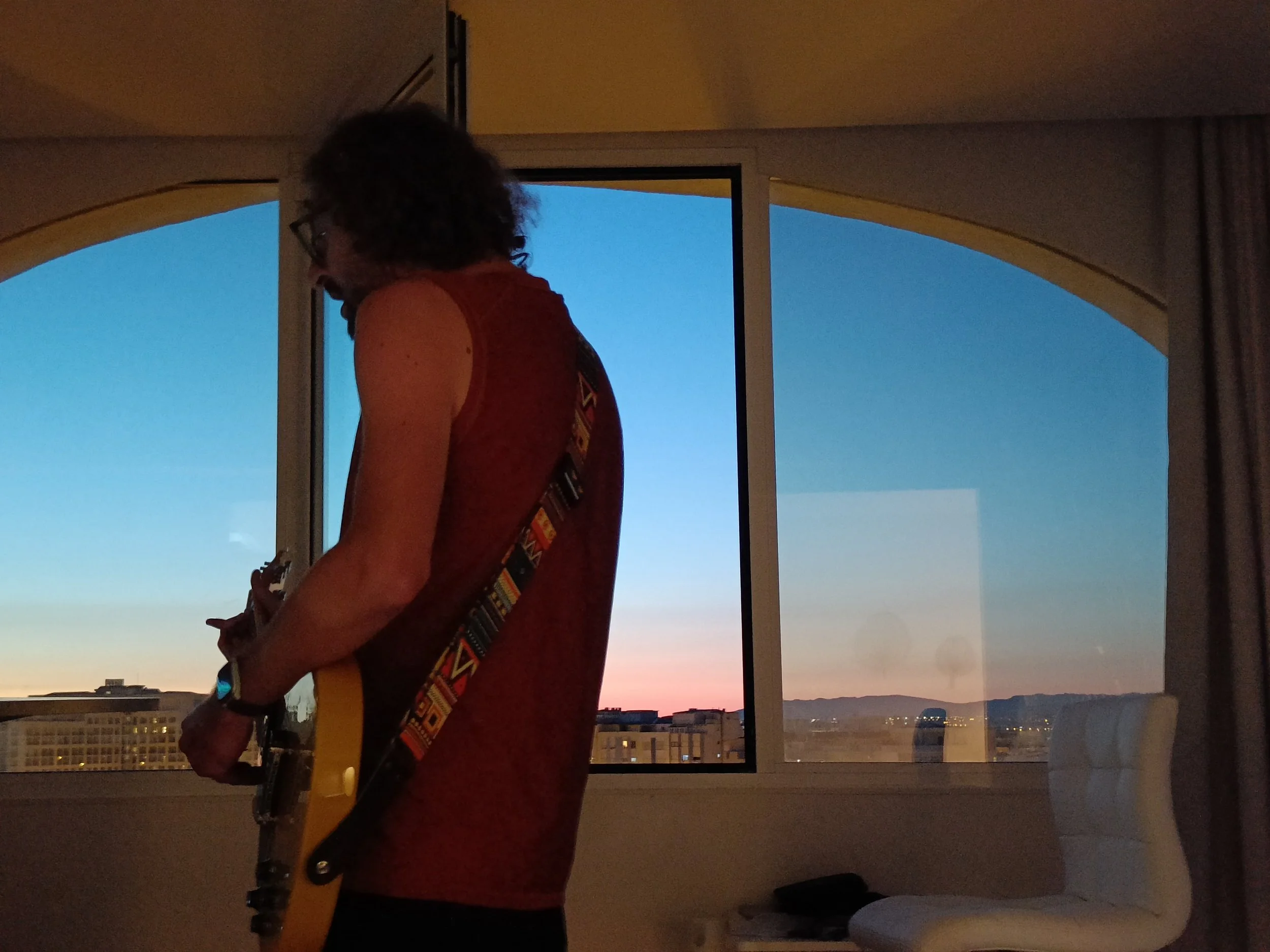
The real leap came when I bought my first left-handed electric guitar.
Suddenly, something changed in the body.
Not everything. Not perfectly. But enough.
For the first time, the guitar felt as if it was sitting in the right place. Until then, with the classical guitar, there had always been a kind of negotiation between two forms of knowledge — what my hands already knew from years of playing right-handed, and the new information they were slowly trying to learn.
The electric guitar changed that balance.
It no longer felt only like a struggle between two techniques. There was more flow. More comfort. More of the physical ease I had been waiting for.
For years, I had said that I wanted the guitar to feel the way a basketball feels in my hand — not like an object I am holding, but like an extension of the body. Something I can move, guide, and respond with almost as naturally as my own fingers.
The left-handed electric guitar gave me the first real glimpse of that feeling.
Not every day is a good day. Some days the hands are slow. Some days the mind is heavy. Some days the body does not seem interested in speed, accuracy, or music at all.
But I no longer understand those days only as failure.
More often, I can read them as information. Information about energy, sleep, mood, tension, or something in me that has not yet settled. A difficult practice can become a kind of weather report from the body.
And strangely, I have come to value those difficult days more than I used to.
They sharpen the good ones. They make the days of flow feel less ordinary. Even during the difficult days, they help create a quiet gratitude for the days when the guitar opens again.
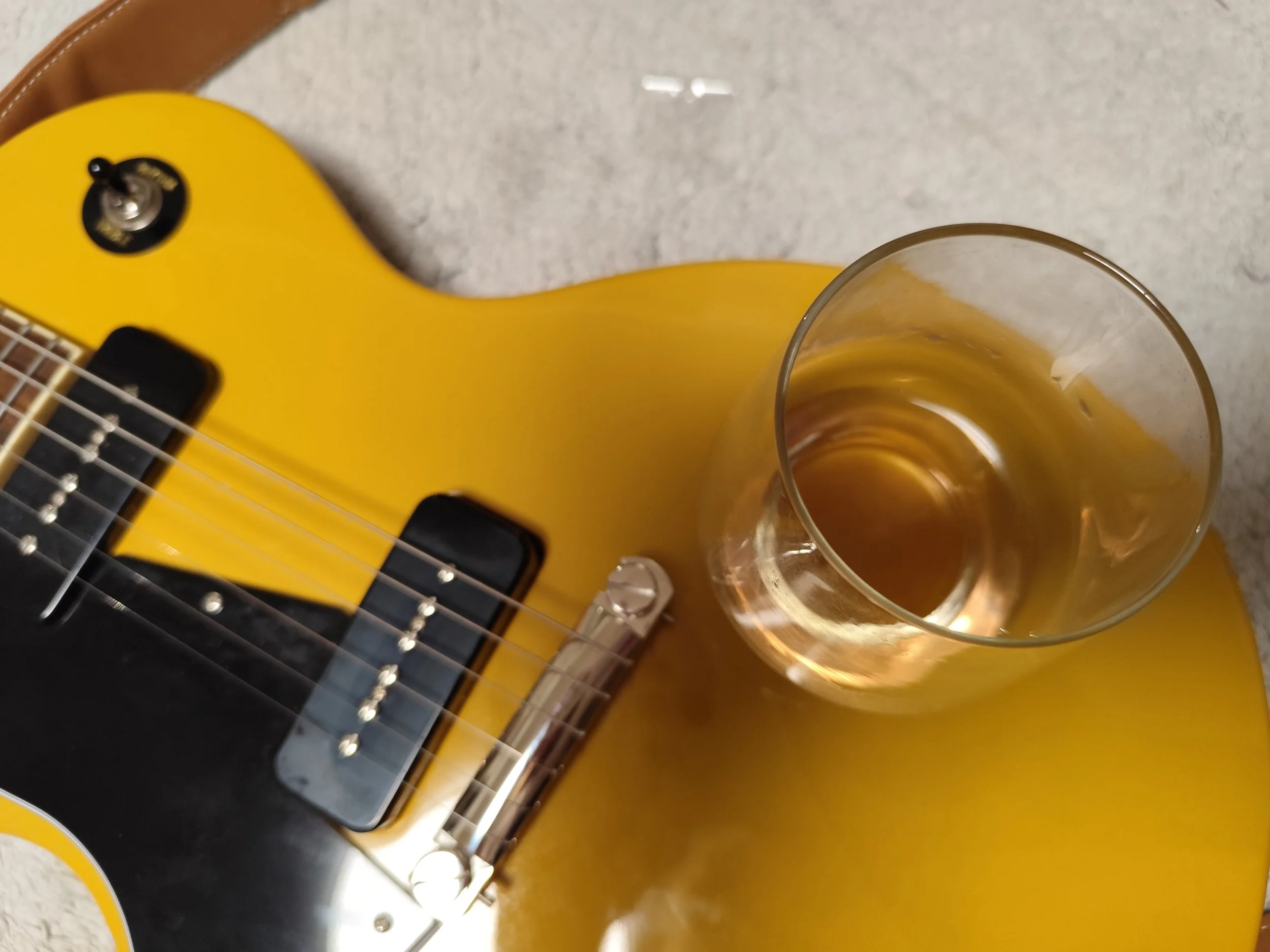
On the good days, it can feel like entering a state I had been waiting for without fully knowing it. The guitar becomes inviting. The hands become curious. One sound leads naturally to the next, and practice stops feeling like something I am trying to complete.
It becomes something I want to stay inside for a little longer.
Like reading a book so good that you pause between chapters, not because you are tired, but because you do not want it to end.
The Function of an Action
This is where ACT gives me a useful language.
Every action we take can move us toward our values — or away from them.
Eating, resting, practicing, speaking, playing music, none of these actions are inherently good or bad. What matters is the function they serve in our lives.
The same action can mean different things at different times.
Playing guitar can be a way to impress someone, avoid silence, perform an identity, or prove something. But it can also be a way to express emotion, connect with sound, enter the body, create beauty, or feel alive.
ACT asks us to look less at the surface of the action and more at its direction.
Where is this taking me?
Toward what matters — or away from it?
For me, playing guitar today is connected to expression, persistence, and a sense of possibility.
It is not only about becoming better, although improvement brings real pleasure. It is about feeling that I can make music in a way that is pleasant to me and, perhaps, to others. It is about returning to something that mattered, and finding a way to meet it more honestly.
Goals Are Not the Same as Values
There is another distinction from ACT that helps here.
Goals are not the same as values.
Goals can be reached, missed, compared, or taken away.
Values are directions.
Expression.
Creativity.
Persistence.
Presence.
Play.
Connection.
You never complete them. You live toward them.
This matters because many activities can become trapped in the wrong frame. We can turn music into proof, sport into comparison, work into status, relationships into performance, and practice into another way to measure our worth.
But when we reconnect with the values beneath an action, the action itself begins to change.
The guitar becomes less of a test.
More of a return.
Less of a performance.
More of a relationship.
Music in the House
Chaya eventually followed me into Yousician too.
At the beginning, she progressed with remarkable speed. Then work, moves, and life pulled her away from it for a while. Later, she returned to something older and closer to her own childhood love — the keyboard.
That has become its own beautiful development.
Today, more and more, we are able to play small pieces together. Not perfectly, not as a performance, not as people trying to impress anyone. Just two people in a room, finding sounds, adjusting, laughing, trying again.
Those moments are among the most uplifting ones.
Because music, when it is shared gently, does something that explanation cannot always do. It creates a small common space shared by rhythm, attention, listening, mistakes, repair, and the simple pleasure of being inside the same sound for a while.
Returning to What Matters
Looking back, I do not think the owner of the music shop meant any harm.
His advice was practical. In another life, for another person, it may have been exactly right.
But a practical answer is not always a values-aligned answer.
Sometimes the easy path is easy because it fits the world around us. It makes sense socially, logistically, externally. But years later, we may discover that it did not quite fit the body, the desire, the direction we needed.
Returning to what matters does not always look dramatic.
Sometimes it looks like starting again, slowly, awkwardly, with the other hand.
Sometimes it looks like admitting that the old way worked, but not fully.
Sometimes it looks like buying the guitar you wanted many years earlier and giving yourself permission to be a beginner again.
The action itself matters less than the direction it serves.
And when the direction is right, even a small act of practice can become a way back to yourself.
