Hi, I’m Chaya.
I have spent many years working in the field of human rights, alongside people whose lives have been shaped by uncertainty, displacement, violence, and danger.
My work has brought me close to people without legal status, asylum seekers, people facing serious medical situations, LGBTQ+ people, and others living through complex humanitarian circumstances. Many of the people I meet are facing some of the most difficult moments of their lives.
This work is deeply meaningful to me, but it is also deeply demanding. Over time, it has helped me see more clearly what it means to live at the margins of society — without status, without security, and often without the simple ability to plan, hope, or move forward safely.
When you spend your days listening to stories of fear, violence, illness, uncertainty, and survival, you carry some of that weight with you.
Art became one of the places where I could put some of it down.
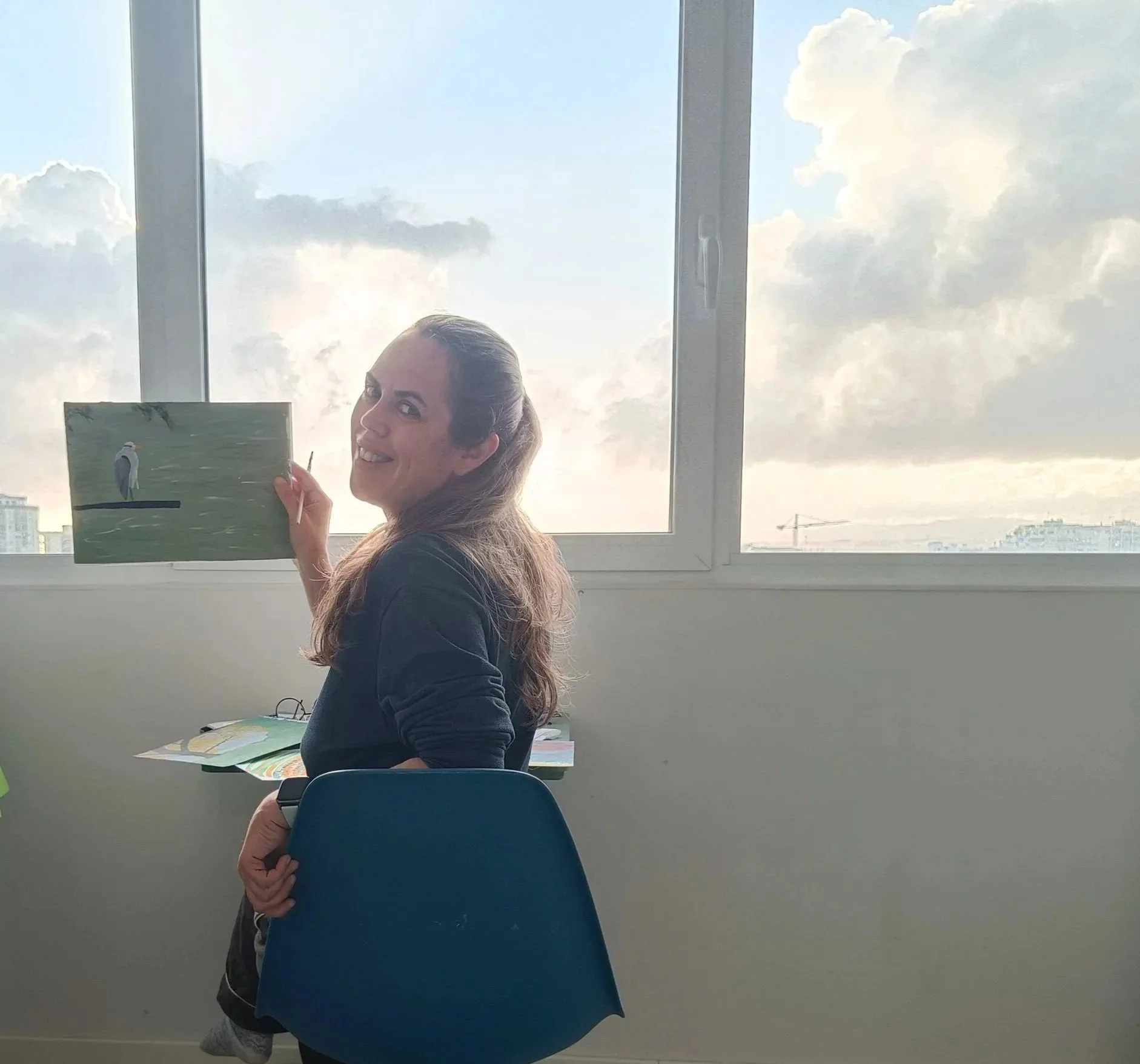
I did not begin painting as a profession, or even with a clear idea of where it would lead. I began in my early twenties, during a difficult period in my life, when I needed a space for myself — somewhere I could sit with colors, brushes, pencils, music, and silence, and allow something inside me to soften.
At first, painting was simply calming. The feeling of the paint, the movement of the brush, the search for colors that belonged together — all of it gave me a way to stay with myself without needing to explain everything in words.
Over the years, painting became more and more important to me. Later, during my years in human rights work, it became a steady weekly practice — a place where I could pause, breathe, process, and return to myself.
For years, I painted mostly in blues and purples. Slowly, I began to try other colors. Slowly, I became braver. Slowly, the paintings changed.
I have never formally studied painting. My work grew from moments when I needed to listen inward, make room for feeling, and find beauty even in difficult seasons.
Today, I see my paintings as something gentle, alive, and unique. I hope others can feel that too.
I grew up in Jerusalem, in a home where English was spoken. Hebrew became the language I learned through school, life, and the city around me. Later, I also learned Arabic — through my life in Jerusalem and through my university studies — and today it is one of the languages through which I connect deeply with people and their stories.
Before my work in human rights, I spent several years teaching languages to children and adults. Teaching gave me another way to be with people — patiently, attentively, and with respect for the different ways each person learns, speaks, and finds confidence.
Jerusalem also held more difficult parts of my story. Alongside the beauty, languages, and intensity of the city, my life there included personal and family challenges that shaped me in deep ways. Art became one of the ways I began to care for myself inside that complexity — not by solving everything, but by giving myself somewhere to breathe.
Yoga and mindfulness became another path.
Through yoga, I learned to breathe with movement, to slow down, to feel my body from the inside, and to return to the present moment. Mindfulness helped me notice what was happening within me without immediately running away from it. With Roei, yoga and mindfulness gradually became more than practices. They became part of our shared way of living.
I met Roei in Jerusalem, when he came there for his doctoral research. Our connection felt immediate, and before long I moved to Italy to live with him — a country that made me feel welcome as soon as I arrived.
In Italy, something in me opened. I fell in love with the rhythm of life — the food, the landscapes, the slower pace, the beauty of everyday rituals, and the way people seemed to make room for pleasure, taste, conversation, and rest.
Creativity also entered my life there through food. I learned to make pizza and handmade pasta in many different shapes — practices that require patience, touch, and attention to detail. Like painting, cooking became a way of slowing down and working with my hands — a practice of care, rhythm, and quiet concentration.
Living in Italy, France, and Portugal also changed the way I notice the natural world. Birds, mountains, rivers, and eventually the Atlantic Ocean became part of my visual and emotional language. In Lyon, I became especially drawn to herons — their stillness, patience, and slow movement near the water. They became one of the forms I returned to again and again in drawing and painting.
Today, living near the ocean in Portugal, nature continues to shape my work. The ocean, birds, flowers, trees, and changing light all find their way into my paintings — not as exact copies of the world, but as traces of attention, feeling, and presence.
This is the place I now call home.
And this is where Coastline Heron was born.
Coastline Heron brings together many parts of my life: art, mindfulness, attention, nature, language, care, and the belief that small acts of presence can matter. At the moment, my creative work here is focused on sharing and selling my paintings — both as prints and, when available, as original one-of-a-kind pieces.
Over time, I hope this space may also grow to include other forms of creative practice — art, food, attention, and simple acts of making. For now, I am happy to begin with the paintings themselves, and with the hope that they can bring some quietness, color, and presence into other people’s homes.
I also hope, with time, to feel more at ease in Portuguese, and to communicate in this language as I do in the others that have shaped my life.
For me, art is not separate from care. It is one of the ways care becomes visible — through color, stillness, attention, and the quiet courage to keep creating.