

About Coastline Heron
For the past decade, we have been building a life shaped by movement, curiosity, creativity, and everyday practice.
What began through conversations, travel, food, art, and shared routines slowly became something deeper. It became a way of approaching life with more attention, flexibility, and presence.
Over the years, baking, cycling, swimming, yoga, creative work, and long walks by the river or the ocean all became part of how we stay grounded — and part of the atmosphere we try to bring into conversations with others. Not as perfection or performance, but as small daily practices that help people reconnect with themselves and move through life with greater clarity and care.
Coastline Heron carries a deeply personal meaning for us.
The name was shaped over many years of movement between homes, countries, conversations, and ways of living. The heron first became part of our shared world during quiet mornings and evenings in Lyon’s Parc de la Tête d’Or, where we would watch the birds rise from the water at sunrise and return again at dusk to the small island at the center of the lake.
Over time, the heron came to represent something we both recognized in our own lives. It was movement without rushing, observation without withdrawal, and the ability to return — again and again — to a quieter sense of presence.
Chaya grew up in Jerusalem, far from the sea or any daily source of water. For me, moving to northern Italy opened a beautiful new world, but also created a distance from the easy presence of the coast. Over the years, we found ourselves returning to water wherever we could. We returned again and again to the Ticino River in Pavia, the beautiful lakes of Lombardy, the rivers of Lyon, lakes a little further away in France and Switzerland, and eventually the Atlantic coast of Portugal.
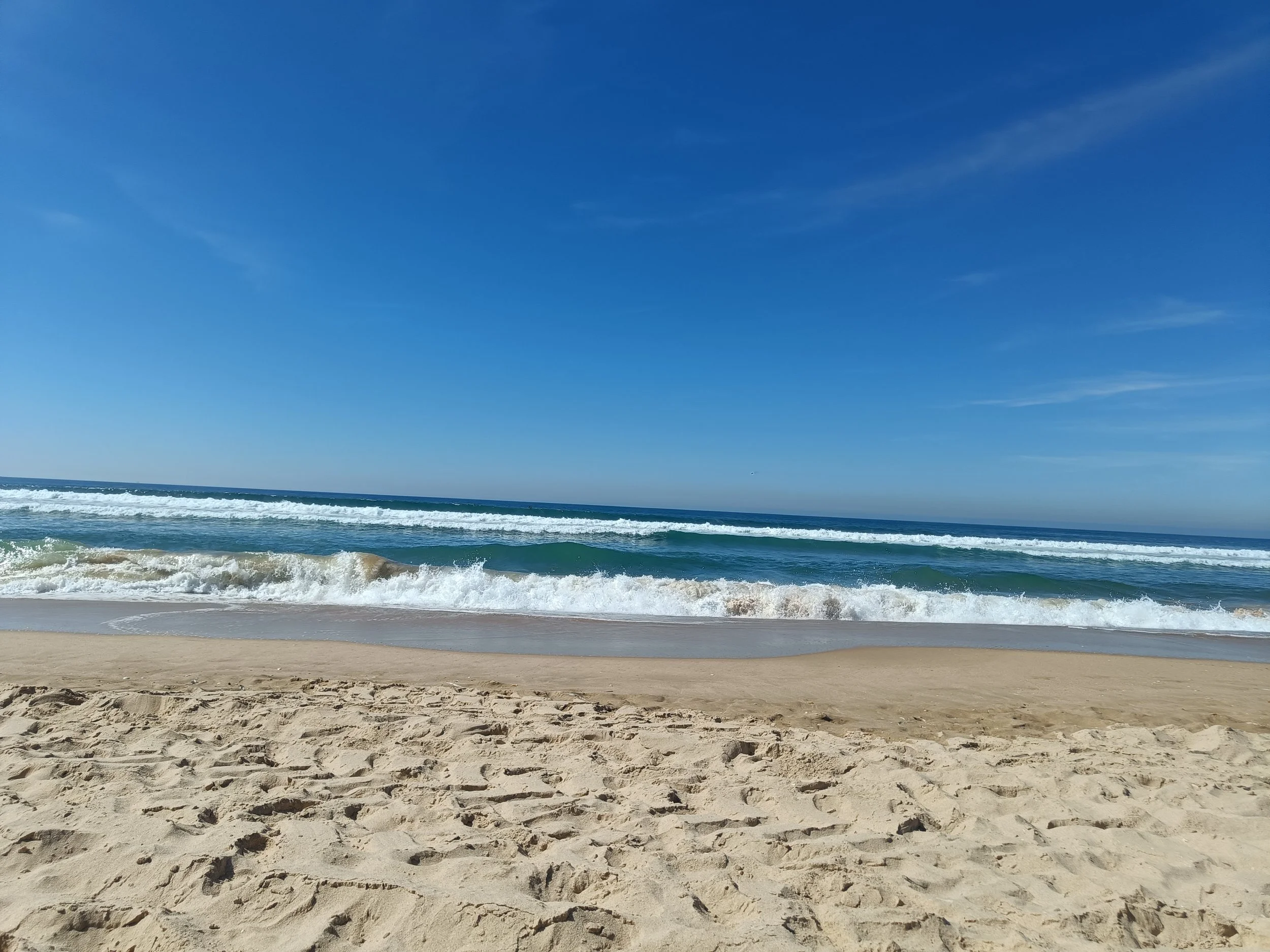
In Costa da Caparica, the ocean became part of daily life rather than a place to visit. Arriving on the Atlantic coast gave that long thread a new form. The ocean became part of the rhythm of ordinary life — something spacious, grounding, and alive.
The four herons that appear throughout the site can be read in two directions.
One direction follows a natural movement of growth: from broad lines, to finer detail, to color and fuller form. The other moves back from the colorful and familiar toward the simplest outline — as if loosening the grip of all the things we have learned to call “me.”
This double movement matters to us. We are always becoming more ourselves, and also learning not to be trapped by any single idea of who we are. In that space, conversation, change, and freedom become possible.
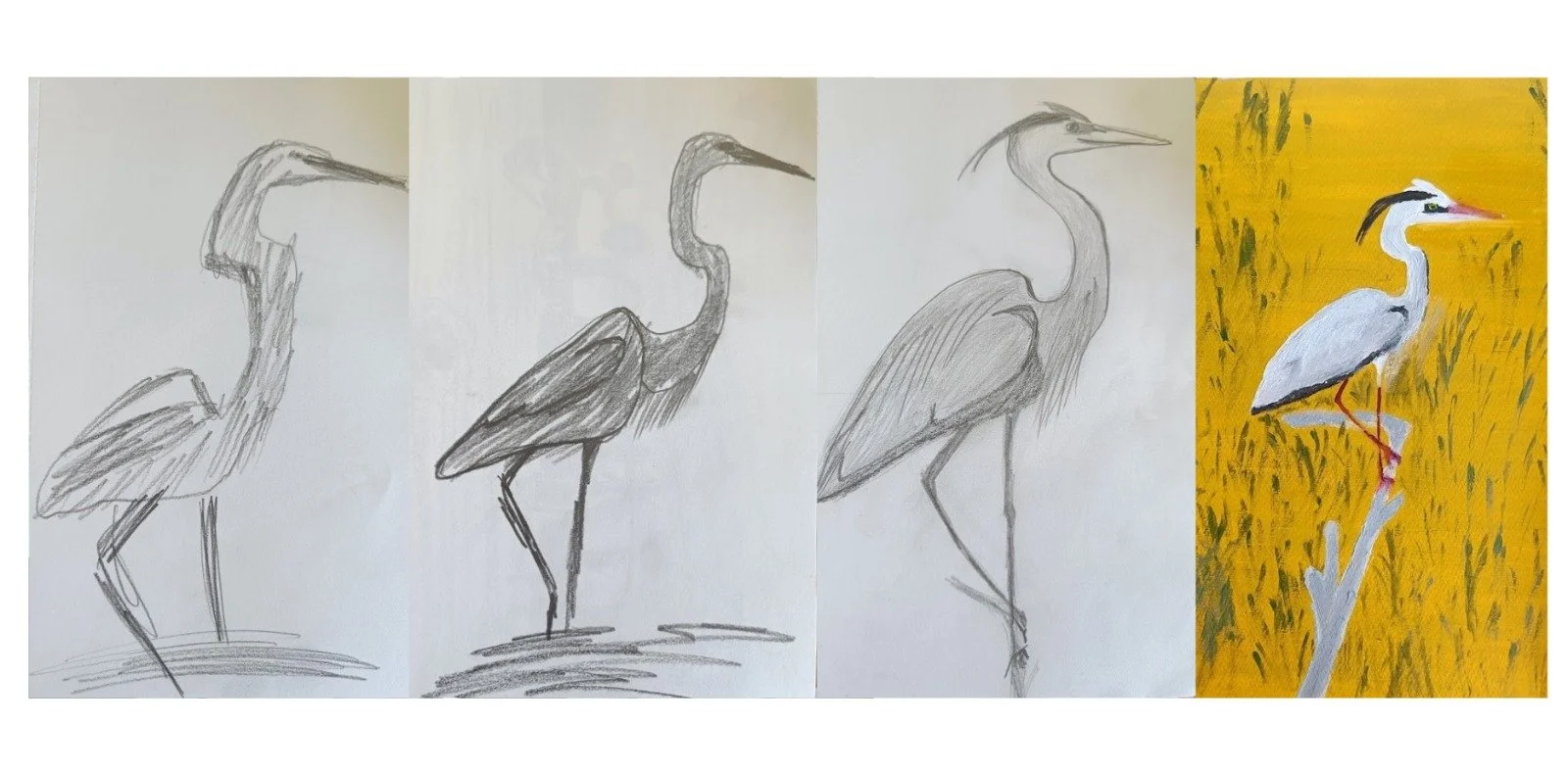
These original heron drawings by Chaya became the visual beginning of Coastline Heron.
Together, Coastline Heron became something we had quietly hoped to build for years — a shared space where our different paths could meet naturally, with conversation, ACT-informed coaching, mindfulness, creativity, art, movement, and emotional reflection existing side by side rather than separately. Instead of dividing life into isolated roles, we wanted to create a way of working together that feels closer to how we actually live: collaboratively, creatively, and with room for both structure and exploration.
What Shapes Coastline Heron
The Person as a Process, Not a Problem
At the heart of our approach is a simple idea. People do not need to be “fixed.” More often, they need space — space to think, feel, reflect, and move without becoming trapped inside fear, shame, rigid expectations, or old stories about who they are supposed to be.
ACT (Acceptance and Commitment Training) offered us a framework that felt both grounded and humane, one that connects psychological flexibility, compassion, mindfulness, and values-based action. Rather than seeing people as problems to solve, we see human experience as something constantly unfolding, changing, and responding to life.
Our work is also shaped by lived experience, movement between cultures and identities, conversations with people across many environments, trauma-sensitive perspectives inspired by Bessel van der Kolk, and addiction-aware perspectives influenced by Gabor Maté — not as rigid doctrines, but as ways of listening more carefully to the emotional realities people carry.
Conversations, Not Authority
We do not believe meaningful change happens through judgment, pressure, or pretending to have all the answers.
The role of the coach, in our view, is not to become an authority figure or someone who “knows better,” but to create conditions where people can reconnect with their own clarity, values, and capacity for movement. We are less interested in giving ready-made solutions and more interested in helping people develop tools they can continue using long after the conversations end.
This is why we see coaching as a collaborative process rather than a hierarchical one — curiosity instead of diagnosis, exploration instead of performance, and reflection instead of quick fixes.
Creativity as Part of Emotional Life
Creativity is not separate from emotional well-being; it is one of the ways people process experience, reconnect with themselves, and create meaning.
Writing, drawing, movement, conversation, baking, breathwork, and everyday rituals can all become forms of grounding and reflection. Coastline Heron was built around this connection between emotional flexibility and creative expression — allowing art, mindfulness, conversation, and coaching to exist side by side rather than in isolated categories.
The goal is not artistic perfection. It is creating enough space for people to notice themselves differently and relate to their inner world with greater openness and less judgment.
Inclusivity and Human Complexity
We welcome people from different cultural backgrounds, genders, sexual orientations, relationship structures, and life experiences.
For us, inclusivity is not branding language or a checkbox — it is a practice of listening without forcing people into predefined categories or moral frameworks. Human lives are often more complex, contradictory, and fluid than the roles people feel pressured to perform.
We are especially interested in creating conversations where people can explore identity, relationships, uncertainty, work pressure, moving abroad, emotional exhaustion, and personal change without feeling reduced to labels or expectations.
Movement Instead of Dependency
Our approach is intentionally designed around autonomy rather than dependency.
Some conversations may be short and focused around a specific transition or challenge; others may continue for longer periods. But the purpose is never emotional attachment to the coach. The aim is to help people strengthen their own ability to make decisions, tolerate uncertainty, remain present with difficult emotions, and continue moving in ways aligned with their values.
We are less interested in perfection and more interested in flexibility — the ability to respond to life with awareness instead of automatic reaction.
Presence, Body, and Awareness
Practices such as mindfulness, yoga, breathwork, movement, and attention to the body can deepen the connection between awareness and everyday life.
These practices are never presented as obligations or universal solutions. They are invitations — optional ways of reconnecting with presence, slowing down mental noise, and creating breathing space inside modern life and work environments that often demand constant performance and emotional suppression.
For us, awareness is valuable not because it removes pain, but because it can create more freedom in how people respond to it.
Freedom as an Ongoing Practice
At its core, Coastline Heron is shaped by a belief in freedom. Freedom from rigid self-stories, from constant self-judgment, from the pressure to always appear certain, and from the idea that someone else holds the “correct” way to live.
We do not see growth as becoming a perfect version of oneself. We see it more as learning how to remain present, curious, and emotionally flexible while continuing to move through uncertainty, relationships, work, change, and everyday life.
Like the coastline itself, this process is never completely fixed. It shifts, evolves, retreats, and returns.
We Are Here For You…
If you have questions, thoughts, or anything you would like to explore before booking, feel free to reach out. We are here to help you understand what working together could look like.