

Crossing The Alps In A Fiat 500
A few years ago, Chaya and I found ourselves at a crossroads.
Not only the metaphorical kind, although there was plenty of that too. A real crossroads: geographical, emotional, relational, and practical. We were living somewhat near Turin at the time, after many years in after many years in our beloved Pavia, and we had started to feel that we did not want to stay there much longer.
It was not because Turin had failed us. It had given us a lot. Italy had given us a lot. But something in us was beginning to ask for a different kind of change. Not just another Italian region, not just another beautiful town, but a chance to meet a culture that was truly different from the one we had learned to live inside.
Around that time, close friends invited us to visit their new apartment in Lyon. It sounded perfect. A weekend in France, people we loved, and a chance to see whether Lyon might become our next home.
It was February. The weather in Turin was mild enough to mislead us. Chaya walked out to our Fiat 500 wearing a light jacket. I walked out in long trousers, a T-shirt, and open sandals — the kind of comfort sandals that seem perfectly reasonable until you find yourself standing in snow — with the unjustified confidence of someone who had not properly looked at a map.
We knew there might be rain on the way. We did not think much of it. The night before, we had even decided to take the longer route, avoiding the toll roads. We have always liked those journeys through small towns, side roads, and little places you would never see if you were only trying to arrive. The trip that could have taken around three hours was now supposed to take around six. That sounded, to us, like part of the pleasure.
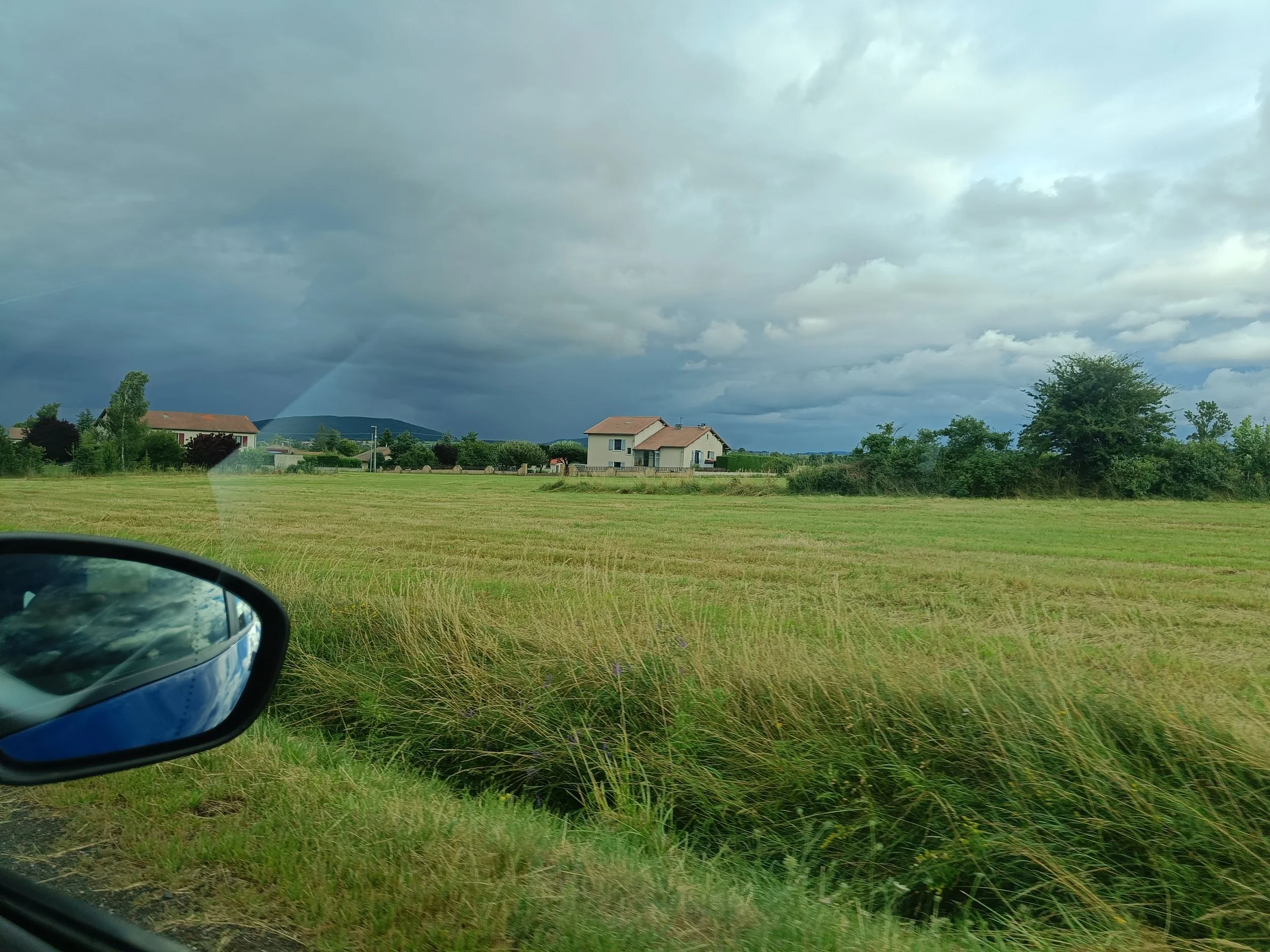
Chaya drove first. The rain began almost immediately. The roads leaving Turin were full of potholes, but she handled them beautifully. We enjoy sharing the driving. There is something both practical and intimate about it, neither of us is simply being carried along. We both take part in the road.
As we got closer to the border, I looked at the hills around us and joked that perhaps I would finally see snow that year. The winter in the town where we lived had not brought any, and I had already made peace with that small disappointment.
A few seconds later, we saw a thin line of white at the edge of the road.
Then another.
Then more and more.
The snow was increasing as we climbed, but the real change happened at the border. It was almost physical — one side still belonged, somehow, to the day we thought we were having; the other side opened into a completely different season. We crossed, and suddenly the world was white.
Somehow, in a way that still feels embarrassing in hindsight, we had not fully registered that we were attempting to cross the Alps on a winter day.
It felt as if we had entered another universe. A small ski town appeared around us — children skiing, cable cars, mountain restaurants, roofs covered in white, and that strange feeling that someone had changed the season without telling us.
We were amazed. And delighted.
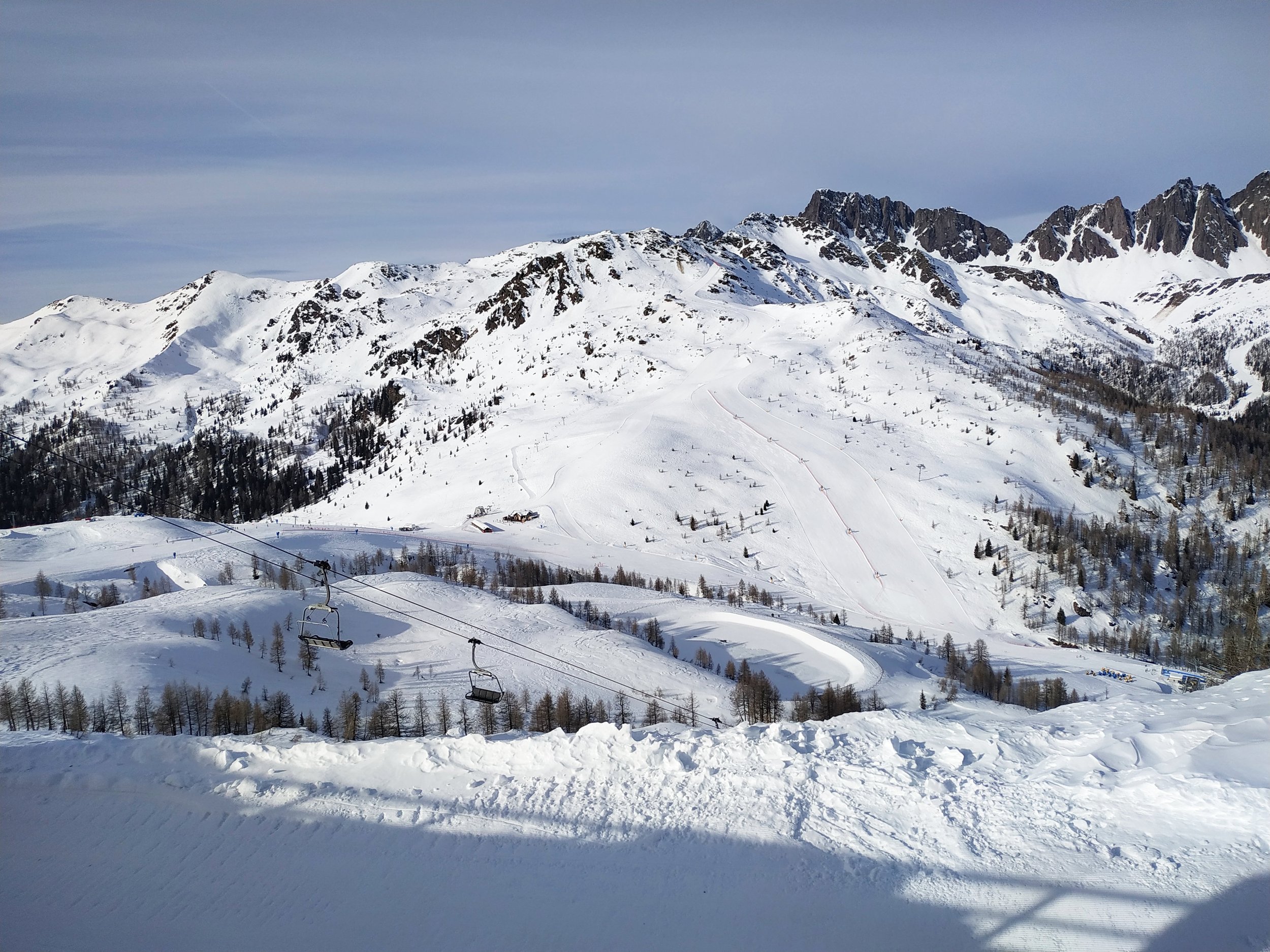
We parked, put on our absurdly thin jackets, and walked into a local restaurant. Inside it was warm, crowded, and alive. France and Italy were playing an important rugby match, and there we were — two people who did not quite belong to the scene, dressed entirely wrong for the weather — sitting among everyone, watching the game, and enjoying the full comedy of the situation.
Outside, the snow kept falling.
Then it fell harder.
Then much harder.
This is probably the right moment to admit another small detail: from the beginning of the drive, we had two navigation apps open. One on Google Maps, one on Waze. They had shown the same route for hours, but one of them insisted that the journey would take an hour longer than the other. We could not understand why. Until that point, they appeared to agree on everything except the future.
When we left the restaurant, we were no longer amused in quite the same way.
Our Fiat 500 was not prepared for this. We had summer tires. We had snow chains somewhere in the car, but “having snow chains” and “being able to install snow chains in real winter conditions” are, as it turns out, two very different things.
We already knew this, in fact. Two winters earlier, when we were still living in Pavia, we had taken a trip into the Oltrepò Pavese. On a steep uphill road, in actual winter conditions, we had tried to put the chains on and failed. After enough cold fingers, confusion, and humility, we had removed them, turned around, and gone back the way we came.
That memory was still with us. It did not make us wiser. It only meant we were aware, with some accuracy, of one of the problems now sitting quietly in the boot of the car.
Then came the decision point.
A junction. One navigation app said left, with an extra hour. The other said right, still promising something closer to the original plan. We were already delayed by the weather and by the warm restaurant full of rugby, but right still looked faster.
So, in a decision that was not our finest, we turned right.
At first it was beautiful. Then it was beautiful and worrying. Then it was beautiful and obviously foolish.
The road became whiter and narrower. The snow thickened. The landscape lost its edges. Chaya was still driving, and eventually it became impossible to continue. The road was so narrow that turning around did not seem possible either.
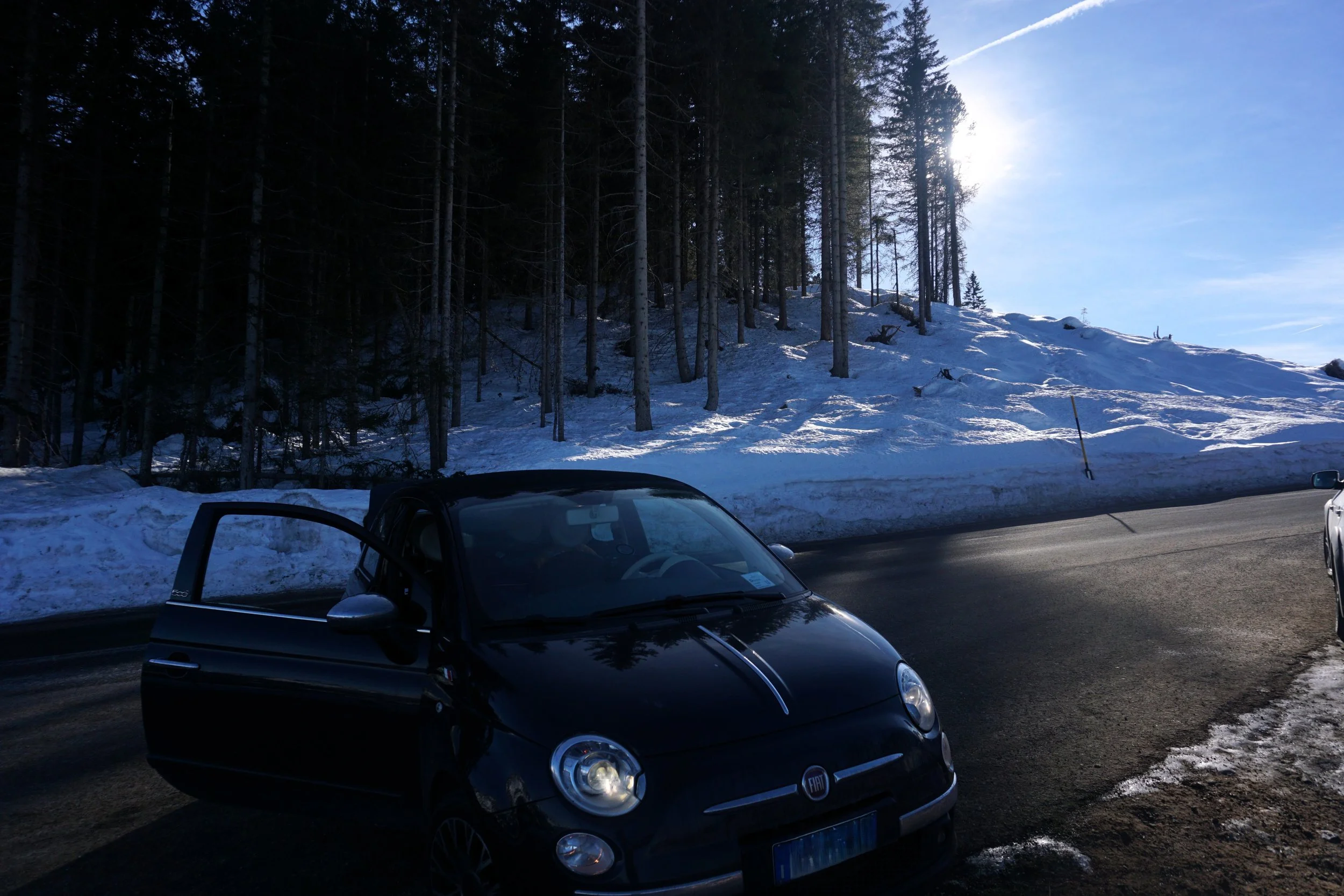
A young French couple were already stopped ahead of us. We stopped behind them, partly because it had become almost impossible to continue, and partly because we hoped they might be able to help us with the chains.
They did not speak English. We did not speak enough French for the situation. But there are moments when language becomes secondary, and the shared meaning is very clear — small cars, wrong road, too much snow, not enough grip.
When we reached them, they were putting their own chains on. They were not trying to escape the storm in the way we were. They had a reservation somewhere inside the mountain, in a small village or refuge, and were trying to get there. Once they had finished with their car, the man kindly tried to help me install ours.
As I mentioned before, all I was wearing were open sandals, long trousers, and a T-shirt, but now I was also standing there on the road with my sandals and bare feet deep in the snow, surrounded by white in every direction, working with a kind French stranger on a problem neither of us could solve. It remains one of my strangest and most vivid memories from all our years of moving between places. It was absurd, generous, cold, and beautiful.
Still no success.
Chaya suggested that we continue just a little farther, hoping to find a place to turn around. That small continuation allowed us to see what had happened. The road was supposed to connect over the mountain and save us a long detour, but the pass was now blocked by the storm.
In one of the more impressive driving moments I have ever witnessed, Chaya managed to turn the car around in the snow, on that narrow curve, and get us back down.
On the way back, we saw the French couple again. Only then did it become clear that they were now completely stuck. The chains they had installed were not working properly; they had become tangled and trapped in the snow, and the wheels would not move as they should. We spoke with them as much as we could, in our limited shared language, before continuing. Darkness was coming.
We returned to the junction where we had made the wrong choice.
Now what?
This was the real decision point, though “decision” may be too generous a word. We were halfway up the mountain. It was around eight o’clock in the evening. We had left Turin at about two in the afternoon, and Lyon was still many hours away. Chaya had been driving for almost six hours, apart from that short stop in the restaurant, and she was exhausted in the way a person is exhausted after holding herself steady through rain, snow, mountain roads, and one impossible turn.
Turning back did not feel like a real option. Stopping somewhere safe and waiting for morning did not feel like a real option either. The storm was not going to politely disappear because we had chosen to sleep. We would simply wake up still in the snow, colder, more tired, and probably more stuck.
The only way out of the mountain was to get out of the mountain.
At that point, I took over the driving. The navigation still showed at least four more hours, which meant five, at minimum, in real life. Going back would take even longer.
So we continued toward Lyon.
We were in the Alps, in the dark, in a Fiat 500, in a snowstorm, wearing clothes chosen by people who had misunderstood the day.
For hours, the drive became almost surreal. I followed the tracks left by the cars ahead of us, because those narrow lines were the only parts of the road with slightly less snow. The task demanded a level of concentration I can still feel in my body when I remember it — do not drift out of the tracks, do not overcorrect, do not panic, do not let the white erase the road.
The falling snow reflected the headlights until the whole world became white. Visibility disappeared and returned in fragments. We moved slowly, carefully, sometimes silently.
And on the radio, of all things, was the final night of Sanremo — the Italian song festival we usually love watching every year. That year we did not watch it. We listened to it while crossing the Alps, tense and exhausted, trying to keep a tiny car moving through the storm.
Then, finally, during the last hour, the roads stopped being white. The snow became rain. The drive became wet, ordinary, almost easy — which felt absurd after everything that had come before. By then we were around the twelfth hour of what had been meant to be a scenic six-hour drive.
Eventually, at around two in the morning, we arrived.
Our friends were waiting for us with warm food and kind faces. We were completely finished. The next morning, instead of spending the weekend evaluating Lyon like thoughtful adults, we drove back home — this time on the toll road, which was clean, smooth, and took about three easy hours.
And yet, somehow, the experience helped us choose Lyon.
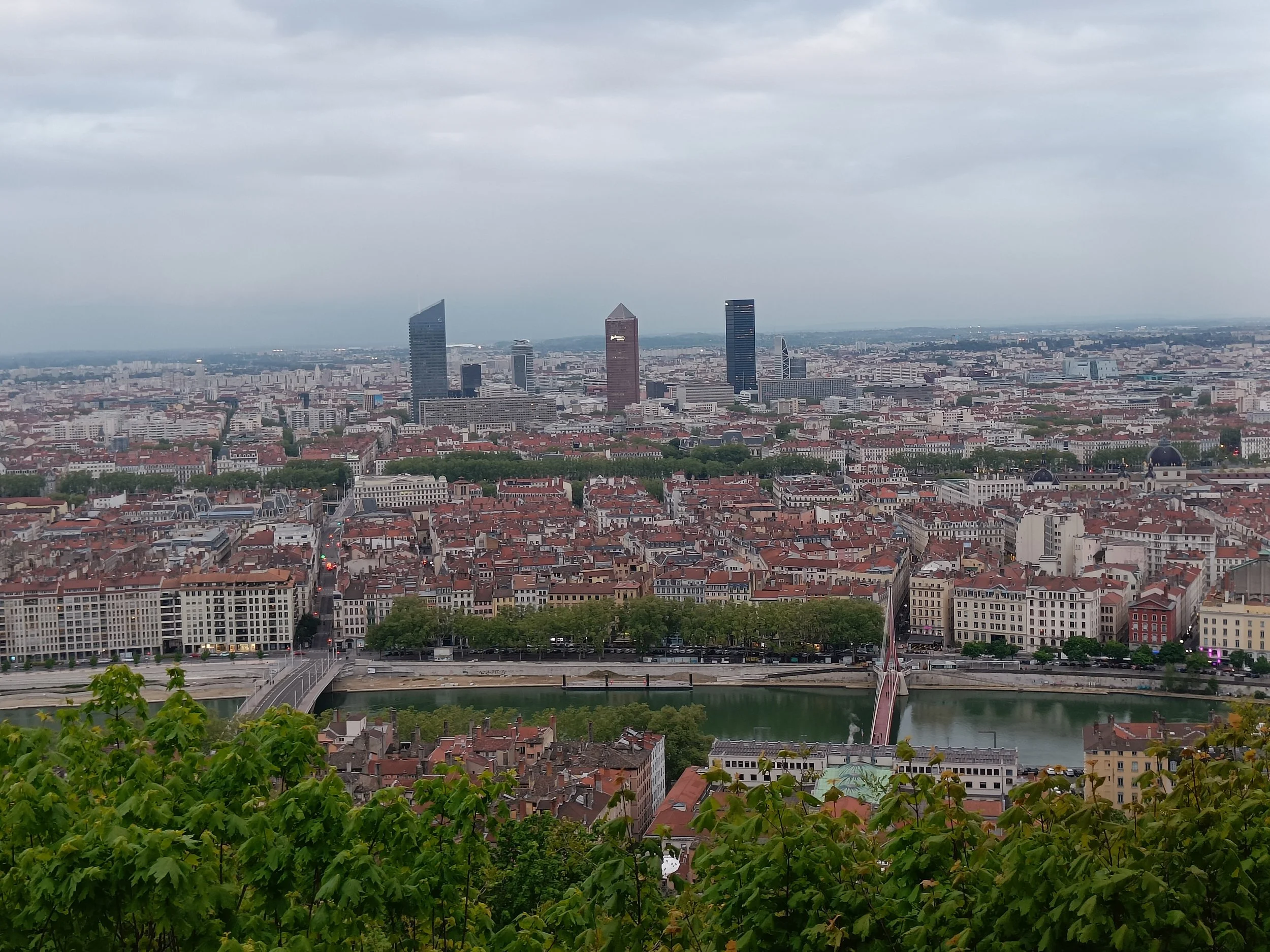
Not because the journey was wise. It was full of inattention, overconfidence, and several decisions that should not be repeated. We had tried to cross the Alps in winter as if we were taking a scenic spring drive.
But it deepened our bond with that little Fiat 500, which had already carried us through so much. In all our years together, that car had never disappointed us. It had climbed astonishing roads in the Dolomites, taken us through the scenic hills of Tuscany, and many other hills, fields, and roads, and now also through a snowstorm in the Alps. It had been more than a car for us. It was another small home, another anchor, a portable piece of continuity in a life that kept changing.
There is a Queen song called “I’m in Love with My Car.” I understand it better now.
I still miss that car. Eventually, we had to replace it. It was old, and it was time for something more solid, more current, more sensible. But sense is not the same as attachment. That Fiat had earned its place in our story.
Something important happened there.
We remembered that we could enter the unknown together. We could make a mistake, get scared, adapt, take turns, continue, laugh later, and still arrive. We could move toward change not because we had perfect certainty, but because we had enough trust, enough shared intention, and enough willingness to meet what appeared on the road.
The move to Lyon, when it came, was easier than that drive. We already knew something about beginning again. We had moved before — across places, languages, habits, and versions of ourselves. In some ways, moving from Lombardy to Piedmont had been no less intense than moving from Turin to Lyon. Each transition had given us a little more confidence, a little more evidence that change can be learned.
There is a particular kind of freedom in making a conscious change.
Not an impulsive escape. Not a fantasy that a new place will solve everything. But a choice that is both emotional and practical. A choice that has meaning, but also logistics. A choice that asks for courage, but also for tyres, maps, and a more realistic relationship with weather.
That balance matters to us.
At Coastline Heron, we often think about change in this way. Not as a clean leap from one life to another, but as a road. Sometimes beautiful. Sometimes poorly planned. Sometimes full of snow you did not expect. The work is not to control every condition in advance. It is to learn how to notice, adjust, stay connected to what matters, and continue with more presence than panic.
We do not always get the route right the first time.
But sometimes, even the wrong turn teaches you something essential about the next home.
