

Playfulness and Shared Games in Relationships
There is something quietly powerful about couples who play together.
Not because they have endless shared hobbies, or because they never get bored, or because every evening becomes a perfect scene of laughter and ease. Real life is not like that. People get tired. Work stretches. Dishes wait. Messages arrive. Plans change.
But play gives a relationship a place to breathe.
It creates a small space where the couple is not only solving, planning, discussing, or managing life. For a little while, the relationship does not need to improve itself. It does not need to become a project. It can simply become alive in another way: curious, light, silly, strategic, focused, surprised.
Not every shared space needs to solve something.
Some spaces only need to be played in.
When Play Becomes Winning
I did not always understand play in that way.
Growing up, I spent long nights at my cousin’s house playing FIFA until dawn, indifferent to the school day waiting for us. The emotional pendulum swung wildly. One of us triumphant and smug, the other frustrated and silent — and then the roles reversed.
It was a loop of victory and defeat, repeated until exhaustion.
There was joy in it, of course. Competition can be exciting. It can sharpen focus, create energy, and bring people fully into the moment. I knew that world well from basketball too: the desire to win, to perform, to prove something, to feel the intensity of the game.
But when competition becomes the only form of play, something narrows. The other person becomes an opponent first, and a companion second.
In relationships, that distinction matters.
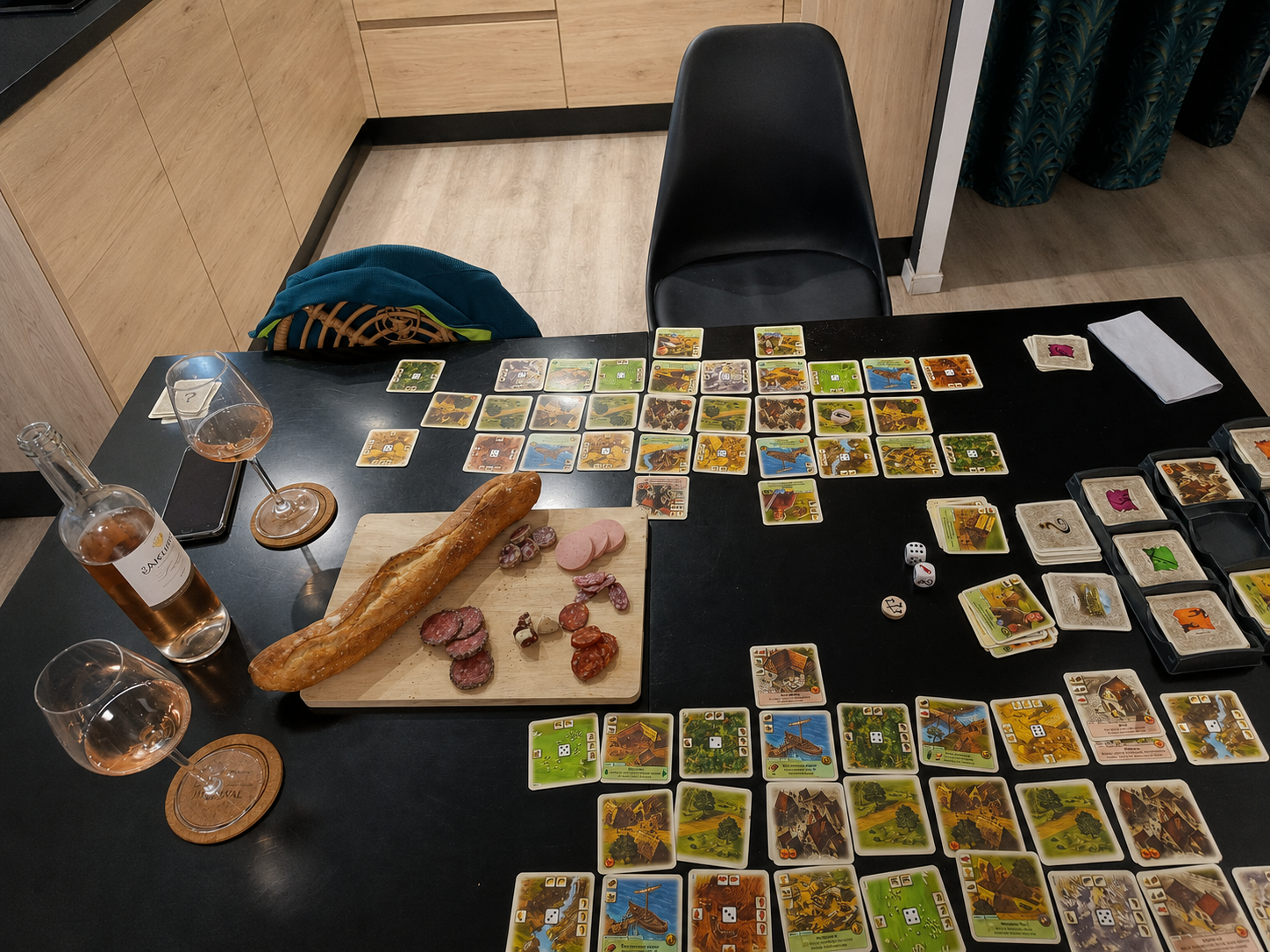
Competition is not the problem. Playful rivalry can be lively, funny, even intimate when both people feel safe inside it. Chaya and I play competitive games too. We have had periods of Monopoly Deal, two-player Catan, digital games, and other games that ask us to think, plan, react, and sometimes lose.
The difference is not whether there is a winner.
The difference is whether winning becomes the whole point.
Games That Come in Seasons
In our life together, games tend to arrive in seasons.
For a while, one game becomes the game. We return to it again and again, sometimes for weeks, sometimes for months. Then, eventually, even a very good game becomes too familiar, and another one takes its place.
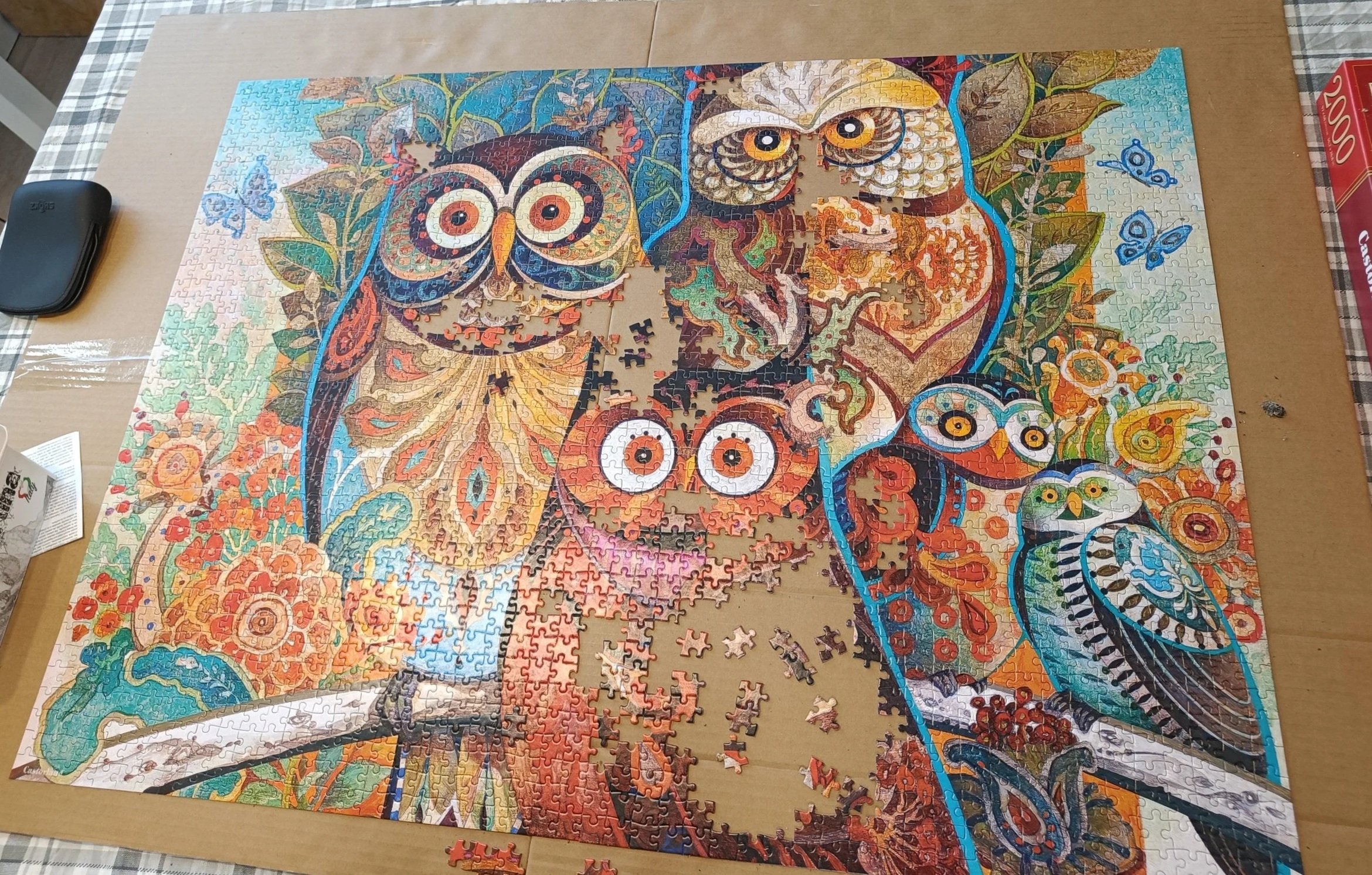
Some seasons belong to cards. Some to strategy. Some to puzzles spread across the table for days. Some to digital cooperation and chaos. Some to the beach.
We have many board games, more than we realistically have time to play. In practice, we often settle into one good game for home and one good game for outside. If life allows, we try to play at least once a day, even briefly — sometimes as a pause in the middle of work, sometimes as a way to mark the end of the day.
That small repetition matters.
A game does not have to be grand to change the atmosphere of a day. It can be ten minutes with cards, a puzzle piece found after staring too long, a short game by the sea, a few rounds of beach tennis or matkot, the simple pleasure of hitting a ball back and forth with no score at all.
On the beach, this is one of the most beautiful forms of play to watch. People passing a ball, not competing, not trying to defeat anyone, just keeping something alive between them.
Sometimes that is enough.
How We Play
Chaya and I do not play in exactly the same way.
She often takes more time with her moves. Not because winning matters more to her, but because she wants to do things properly. She wants to make the best effort she can make, to understand the move, to respect the game. If she does not win, nothing dramatic happens. It may only become part of a joke between us, a small performance of complaint or triumph, playful rather than serious.
I tend to be more spontaneous. I like trying clever moves, even if they might fail. Sometimes I prefer to see what happens. Sometimes the experiment is more attractive than the safe choice.
Against Chaya, I do not feel especially competitive. That is not because I never knew competition. I did. Very much. But mindfulness, practice, and life itself have softened something in my relationship with winning. I still enjoy playing well. I still enjoy a good move. But I am less interested in turning every game into a test of myself.
This, too, is part of playfulness in a relationship: learning how to bring your style without making it the only style in the room.
A shared game becomes a small meeting between different temperaments. One person thinks longer. One person moves faster. One person wants the right structure. One person wants to try the risky path. If the game is held gently enough, the difference does not become a problem. It becomes part of the fun.
Building Something Beautiful
One game that captures this beautifully for us is Wingspan, the board game about birds, habitats, and ecosystems, designed by Elizabeth Hargrave.
Each player collects bird cards, food tokens, and eggs to build habitats. Technically, there is a winner. But the interaction between players is gentle, and the experience often feels less like combat and more like parallel creation.
The beauty of Wingspan lies in its rhythm: calm turns, strategic choices, beautiful illustrations, and the quiet satisfaction of building something alive.
When Chaya and I play digitally, we rarely track the score until the end. We do not really know who is winning, and most of the time we do not care. Sometimes we have a feeling and we are right. Sometimes the ending surprises us completely. A close finish can make us laugh. A dramatic victory can become its own small joke.
But much of the pleasure happens before the score.
We admire the birds. We laugh at their names: Curlew, Common Loon, Ruff, and all the other strange and wonderful forms a bird can take in language. We notice where they live, what they eat, how they look, and what kind of small world each card carries with it.
The European cards are especially enjoyable because some of the birds leave the game and enter reality.
Near our home, on the way to the sea, there is a street we sometimes call “bird street.” The trees are full of movement and sound: goldfinches, sparrows, swallows, black redstarts, and many others we are still learning to recognize. After playing Wingspan, a walk to the beach can feel different. A bird is no longer only a bird. It is a name, a habitat, a flash of color, a question.
The game sharpened our attention.
It gave us another way to share the world.
Learning to Play Together
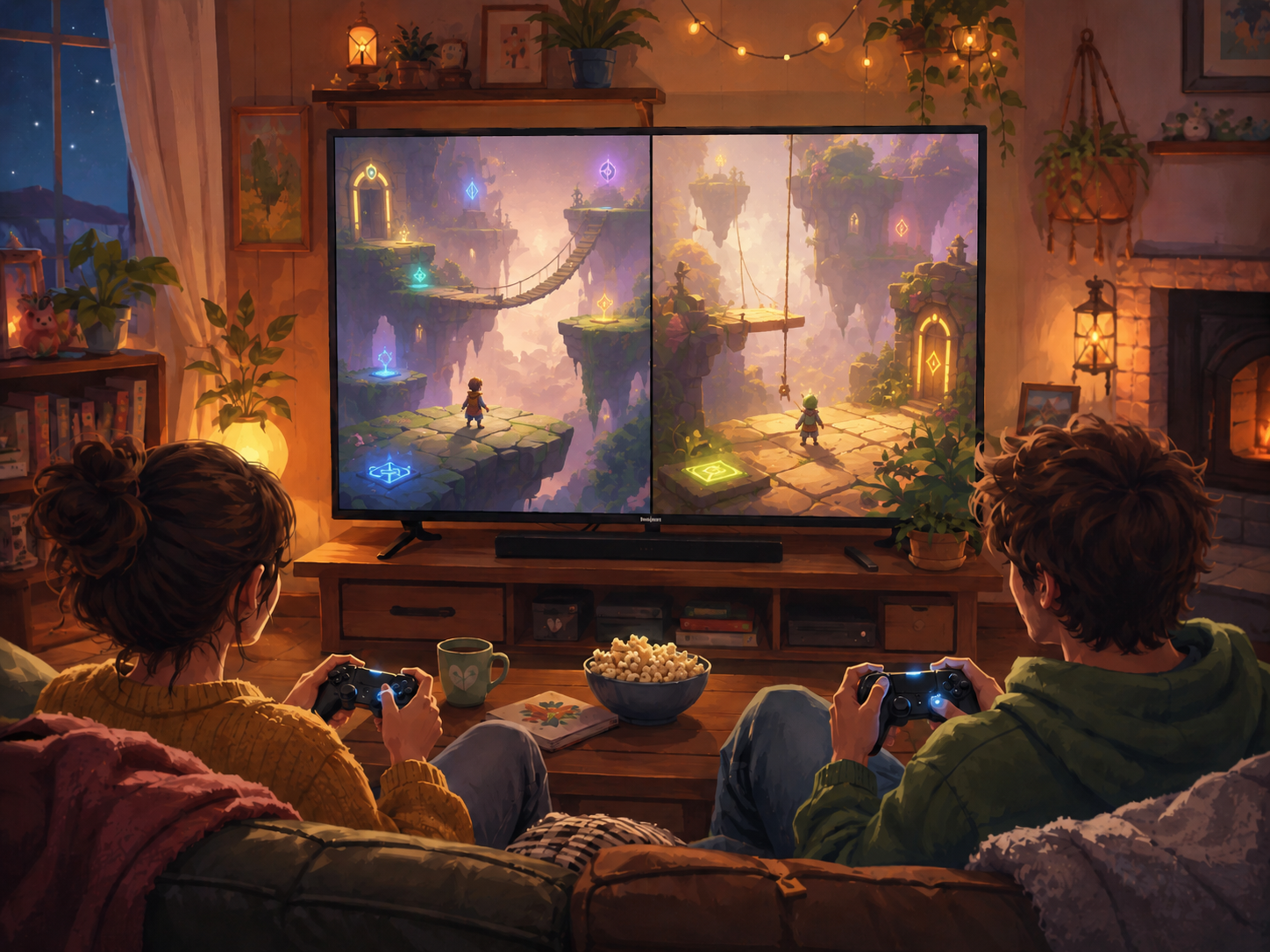
One of the clearest examples of this, for us, was It Takes Two.
It may be the best digital game we have ever played together.
Not only because it is beautiful, imaginative, funny, and full of surprises, but because it understands something important about shared play: two people do not need to be equally skilled in order to become involved. They need a world that teaches them how to meet each other.
The game is built entirely around cooperation. One player controls Cody, the other controls May, and the two cannot move through the story alone. Again and again, the game gives each of them different abilities, tools, or bodies. One may have a hammer while the other throws nails. One may create something that the other can ignite. One may control time while the other creates a copy of herself. In another moment, they may attract or repel each other through opposite magnetic forces.
The point is never simply that both players are present.
The point is that each player needs the other.
That is what made the game so memorable for us. It did not ask one person to carry the game while the other followed. It kept changing the rules, changing the bodies, changing the rhythm. Sometimes one of us understood faster. Sometimes the other did. Sometimes we laughed because we failed in exactly the same place again and again. Sometimes the game quietly taught us what to do before we fully understood that we were learning.
There is something generous in that design.
It allows people who were not “born with a joystick in their hand” to enter the experience. It gives the body time to adapt. It lets the player become a doll, a plant, a bee, a small moving thing inside a huge world — and through that transformation, it makes the controller feel less like a technical device and more like a way of participating.
For me, that is one of the deepest forms of playfulness in a relationship.
Not just winning together.
Not just spending time together.
But entering a strange world together, being confused together, learning the rules together, and slowly becoming more capable than either of you was at the beginning.
Playing Without Speaking
Another game I love for what it reveals is The Mind.
Its rules are simple and strange: players have numbered cards and must place them in order, but they are not allowed to speak. The whole game depends on timing, attention, and a kind of shared intuition.
It is a small game, but it shows something beautiful about cooperation. You cannot force the rhythm. You cannot explain your way into it. You have to wait, sense, misread, adjust, and try again.
That is a very different kind of play from trying to defeat someone.
It is closer to listening.
And like many good games, it creates a little model of something larger. How do we coordinate when we cannot control the other person? How do we act together without perfect information? How do we recover when we misread the moment?
A game can hold these questions lightly.
That is part of its gift.
Small Islands of Relief
Games and puzzles have followed us through many periods of life.
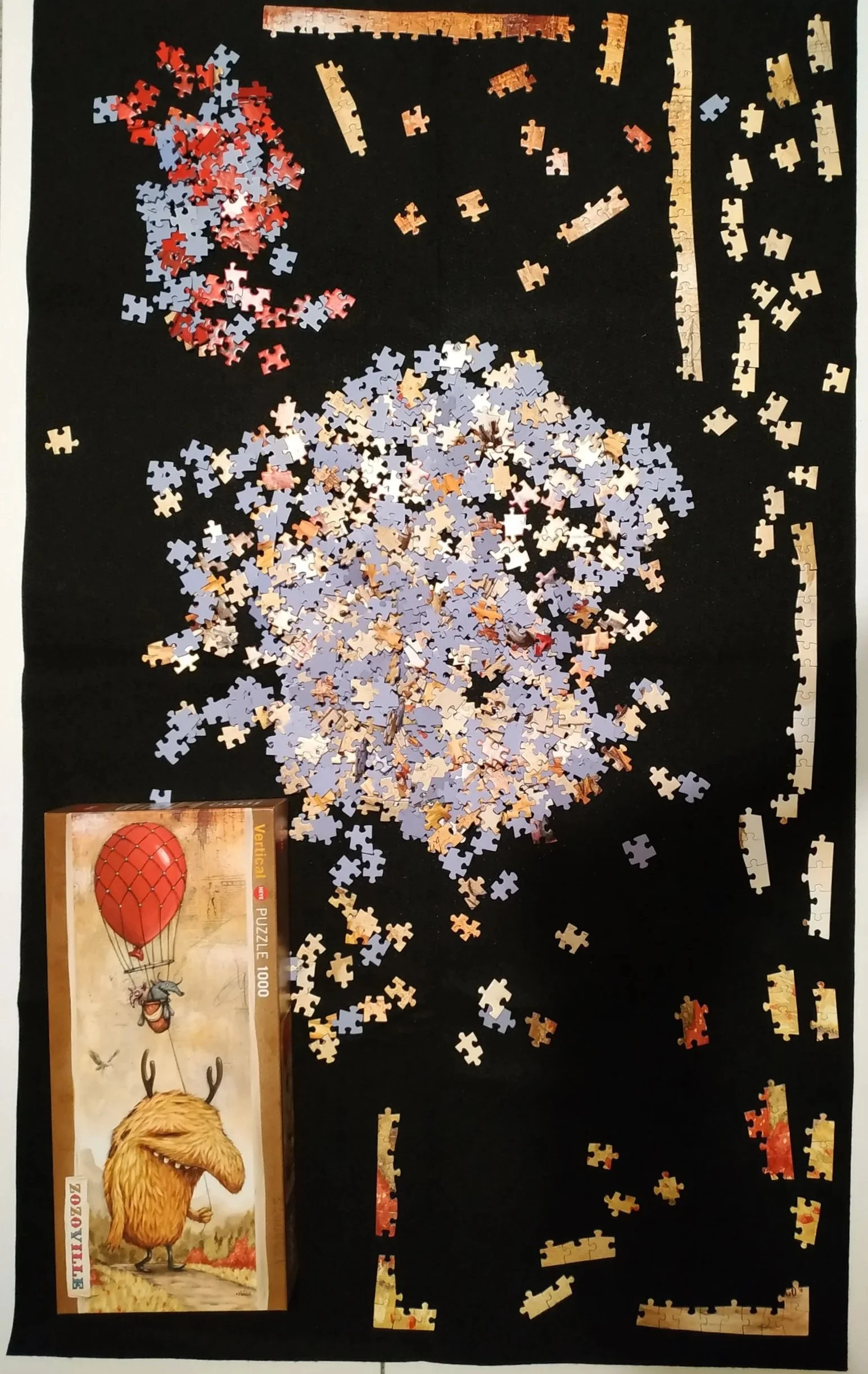
During transitions, moves, stressful stretches, quiet evenings, heavy workdays, or times when the outside world felt uncertain, they gave us a way to return to something small and manageable. A puzzle on the table. A game in progress. A rulebook. A shared laugh. One more round.
This is not escapism in the shallow sense.
Sometimes stepping into a game is a way of letting the nervous system exhale. It gives the mind a shape to hold, the body a reason to sit or move, and the relationship a space that is not only about pressure, logistics, or serious conversation.
There is rest in that.
There is connection in that.
There is also creativity. Games with drawings, birds, colours, patterns, maps, cards, and small pieces invite a childlike part of us without making us childish. They let adults enter play without embarrassment.
And sometimes that is exactly what a relationship needs.
Partners, Not Opponents
A relationship does not become healthier because a couple never competes.
It becomes healthier when the couple has more than one way to meet.
Sometimes we challenge each other. Sometimes we cooperate. Sometimes we build separate things side by side. Sometimes we throw a ball back and forth with no score at all. Sometimes we sit over a puzzle and say almost nothing. Sometimes we play a demanding game and come out mentally tired. Sometimes we choose the simple one because the day has already been enough.
The important thing is not the game itself.
It is the quality of the shared space.
Does it make room for laughter?
For ease?
For experimentation?
For repair after a bad mood or a silly defeat?
For meeting each other without needing to solve anything?
Playfulness does not replace communication, commitment, or care. But it can support all of them. It reminds a couple that the relationship is not only a place where problems appear. It is also a place where life can happen.
A place to rest.
A place to build.
A place to move.
A place to play.
Try it yourself. Choose something small. A card game, a puzzle, a ball on the beach, a cooperative game, a shared challenge with no serious stakes.
Let the point be not to win, or even to improve the relationship.
Let the point be to enter a space together and see what becomes possible there.
