

The Body Leads: Mindfulness as the Meeting Point of ACT and Yogic Wisdom
Many of us have learned over time that the most effective way to keep our week flowing well is to protect space for the activities that nourish us — whether that’s physical exercise, time to disconnect, drawing, being in nature, or other practices that help us feel grounded and alive. Yet within the reality of a busy weekly schedule, these very activities often get pushed to the margins. We find ourselves caught in an ongoing tug-of-war between the things we want to do — the ones we know will improve our quality of life — and the things we have to do: work demands, taking the children to their activities, cleaning, basic self-care, and the endless stream of small but necessary tasks. Over time, even the activities we love begin to feel like just another obligation. They get done in a rush, and the deeper sense of value, meaning, and nourishment that once came from them slowly dissolves.
It is therefore understandable that many people turn to the rich and time-tested wisdom of Eastern traditions — mindfulness, yoga, and contemplative practices that offer powerful tools for reducing unnecessary suffering and reconnecting with presence and compassion. These teachings have helped countless individuals find clarity and inner steadiness. However, engaging with them in a meaningful way often requires a level of dedicated time, consistency, and lifestyle change that many people simply do not have available within their current circumstances.
This is where Acceptance and Commitment Therapy (ACT) offers a particularly relevant bridge. ACT draws from the core insights of mindfulness traditions while remaining firmly grounded in the realities of modern Western life — with all its competing demands, contradictions, and limited time. Unlike traditional Buddhist teachings, which generally present a relatively fixed set of values and a clear path toward liberation, ACT invites each person to actively explore and discover their own values. It does not ask you to adopt a pre-defined list of what should matter; instead, it supports you in clarifying what you want your life to stand for, in the midst of your actual daily reality.
ACT recognizes the deep importance of identifying and living according to our values. At the same time, it acknowledges that we frequently confuse values with wants or feel torn between two things that both feel genuinely important — for example, being a dedicated and effective professional while also being a present and caring parent. What may appear as a painful values conflict is often, from an ACT perspective, more usefully understood as a challenge of time management and prioritization. Learning to navigate these practical tensions with greater psychological flexibility is given just as much attention as working with difficult thoughts and emotions.
The combination of ACT with embodied mindfulness practices allows us to draw from the best of both worlds. We can choose how deeply we wish to explore the philosophical ideas behind these traditions — many of which are increasingly supported by scientific understanding of the brain and human functioning — or we can focus primarily on building the psychological flexibility needed for a more satisfying, values-aligned life, without having to commit to one path exclusively. Both approaches help us bring presence and care into everyday life without requiring a complete overhaul of our circumstances.
One gentle practice I often return to illustrates this meeting point in a very simple way. It can be done as a short, standalone five-minute exercise at any point during the day — whenever you need a quick moment to reconnect with your body and breath — or, if you prefer, as part of a longer warm-up after some initial stretches and grounding. (I should note that I am not a yoga teacher; this is simply a personal movement I learned from a teacher and have found helpful.)
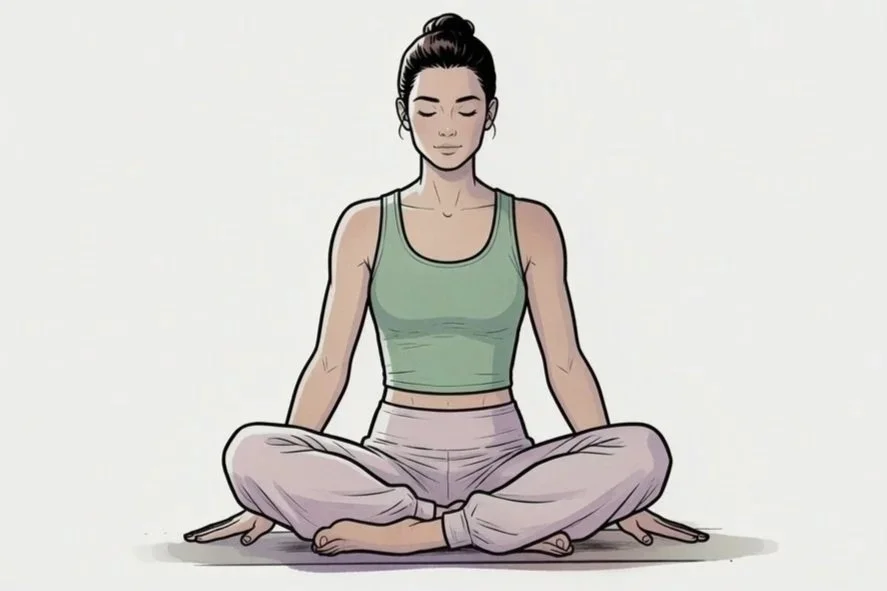
1. The starting point of the sequence — hands resting beside the body, ready to move with the breath.
Sit in a comfortable position, spine relatively upright yet natural. Begin by noticing your natural breath. On an inhale, slowly raise both arms out to the sides to about shoulder height, palms facing forward, while keeping your gaze forward. On the exhale, bring the palms together in front of the heart center, and you may gently close your eyes. On the next inhale, separate the hands and raise both arms high overhead, stretching upward as you gently look up toward the sky. On the exhale, slowly lower the arms and the gaze, allowing the hands to come to rest near the floor. Pause, and begin the cycle again.
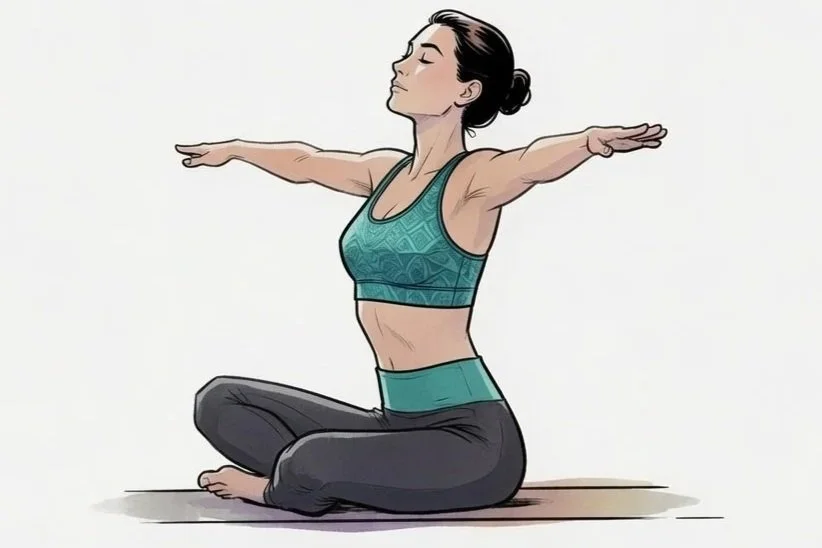
2. Raising the arms to shoulder height on the inhale — engaging with the present moment.
The movement is not about stretching or building strength. It is about synchronizing breath and motion in a steady, repeating rhythm.
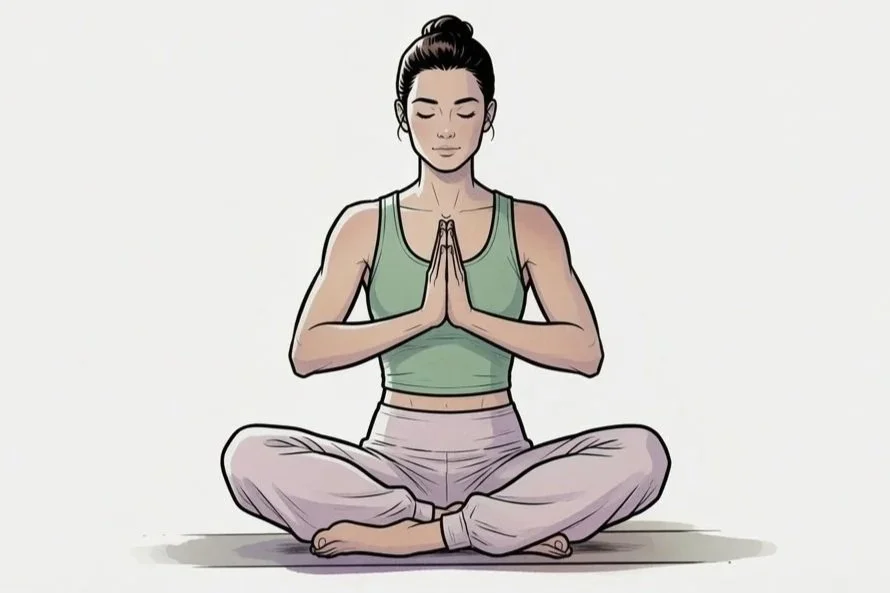
On the exhale, slowly bring the palms together in front of the heart — a moment of Acknowledge. Notice what you feel and what is present.
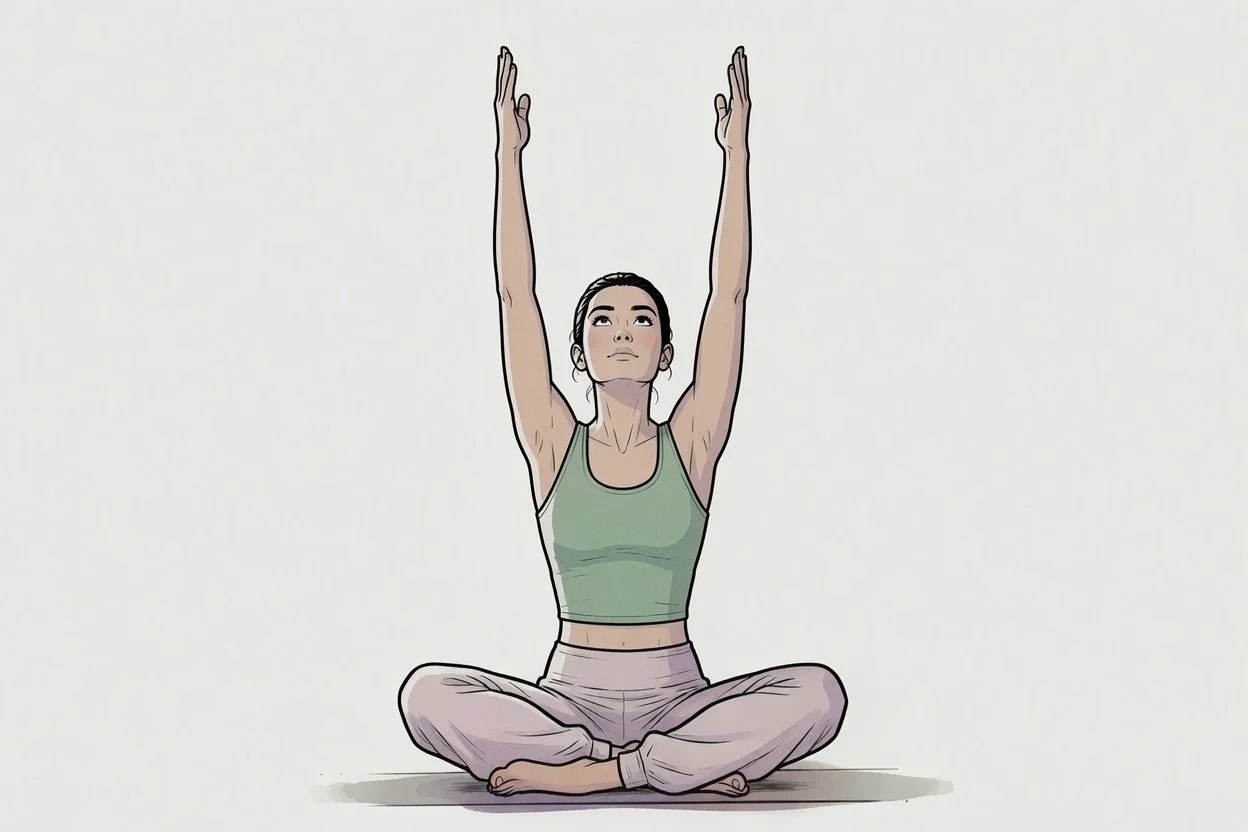
3. Raising the hands upward on the inhale while looking at the sky — expanding awareness and engaging with the space around you.
In the yogic view, this kind of practice works with prana — the vital energy or life force. Bringing the palms together at the center of the body draws attention to the heart center, inviting a quality of centering and quiet intention. Raising the arms upward opens the chest and symbolically reaches or offers toward spaciousness. Lowering them back to the earth grounds the energy and returns you to present support. The repetition itself trains steadiness of mind without force — a moving form of meditation that calms the nervous system and cultivates presence.
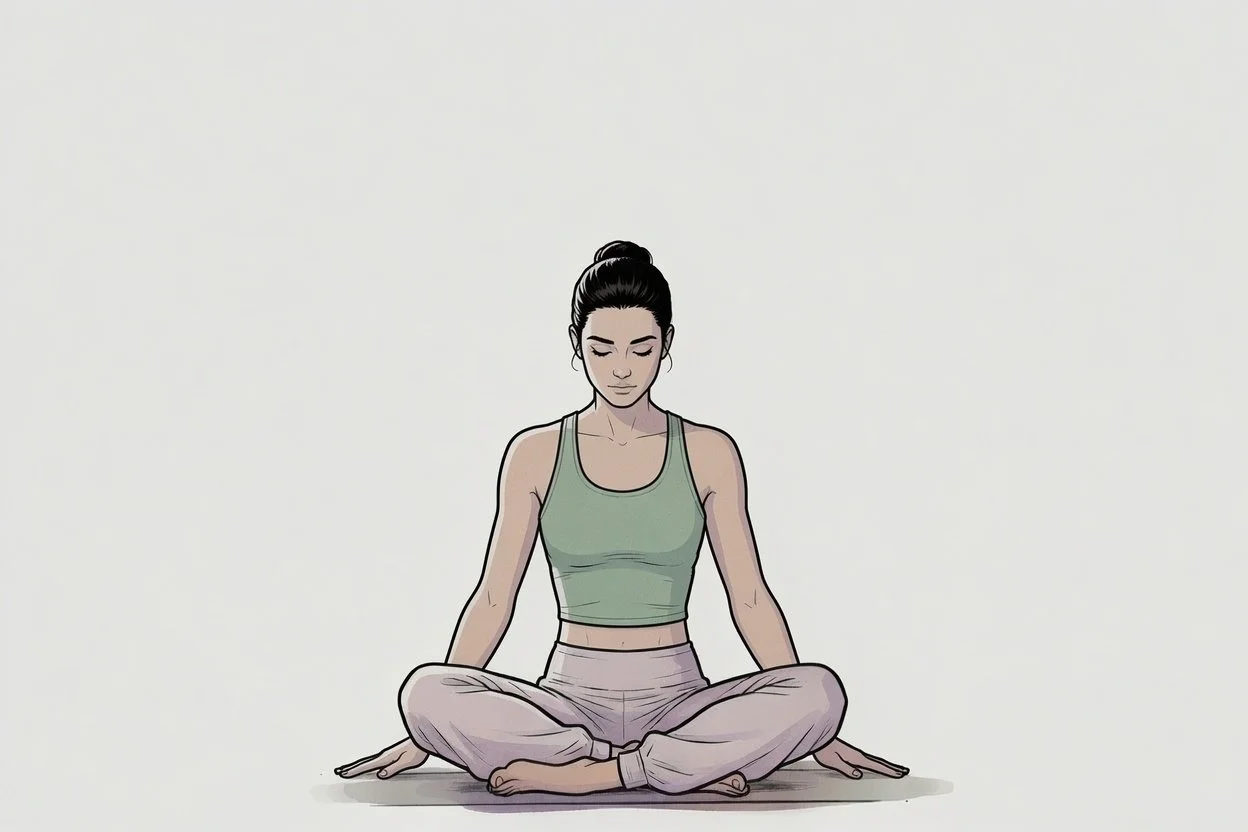
4. Lowering the hands on the exhale — returning to Engage with what you are doing, with whom, and in this present moment.
When we meet this simple movement through the lens of ACT and the ACE practice, it becomes a living, embodied way to cultivate presence. Because the sequence has four clear moments, we can meet each one with intention. The yogic quality of the movement naturally invites us to return to the body throughout the cycle, while the ACE lens helps us toggle — gently moving our attention between turning inward and re-engaging with what we are actually doing in our life right now.
Raising the arms out to the sides on the inhale, with the gaze forward — This is a moment of Engage. Notice what you are doing right now, with whom, and where you are. Are you practicing alone or with someone? What is the time of day? What is the space you are in?
Bringing the palms together in front of the heart on the exhale, possibly closing the eyes — This becomes a moment of Acknowledge. Notice what you feel in the body, what emotions or thoughts are present, and what is alive for you in this moment.
Separating the hands and raising both arms high overhead on the next inhale, stretching upward while looking toward the sky — This invites both Come back to the body and Engage with the space around you. Feel the stretch, notice your body within the environment, and gently open your awareness.
Lowering the arms and the gaze on the exhale — This returns to Engage with your current activity. Notice again what you are doing, with whom, and reconnect to the present moment and task. Then begin the cycle again.
I usually repeat this cycle about five times in one practice. My intention, across different sessions, is to gradually lengthen the breath a little more each time I return to the movement. This naturally allows the movement itself to slow down and become more spacious, turning the sequence into a quiet meditation in motion.
The real strength of this practice lies in the meeting between the embodied movement and the ACE framework — two different approaches to mindfulness coming together in one simple, flowing action. The body movement gives ACE a tangible, physical home, while the ACE lens gives the movement a clear psychological intention. Each cycle offers a gentle toggle: we turn inward to acknowledge what is happening in the body and mind, and then we turn outward again to reconnect with our activity, our environment, and the people around us.
Yet the deeper invitation is to realize that you can practice ACE anywhere and in any situation — with or without the full movement. Whether you have thirty seconds or five minutes, you can simply pause. You can connect with your body, for example by gently bringing your fingertips together or placing a hand on your chest. You can notice what you are feeling and what you are thinking. You can move a little if you wish, look around, and notice what you see. Then you can reconnect to what you are actually doing right now — working, washing dishes, playing, talking with someone, or simply being. Notice when and where you are, and with whom. This simple act of stopping and noticing is already a powerful form of mindfulness that helps us live more consciously, even in the middle of ordinary daily life.
If this kind of embodied mindfulness speaks to you, and you are curious about how ACT-informed coaching can support you in clarifying what matters and moving toward it with greater steadiness and care, I invite you to begin with a free introductory conversation.
